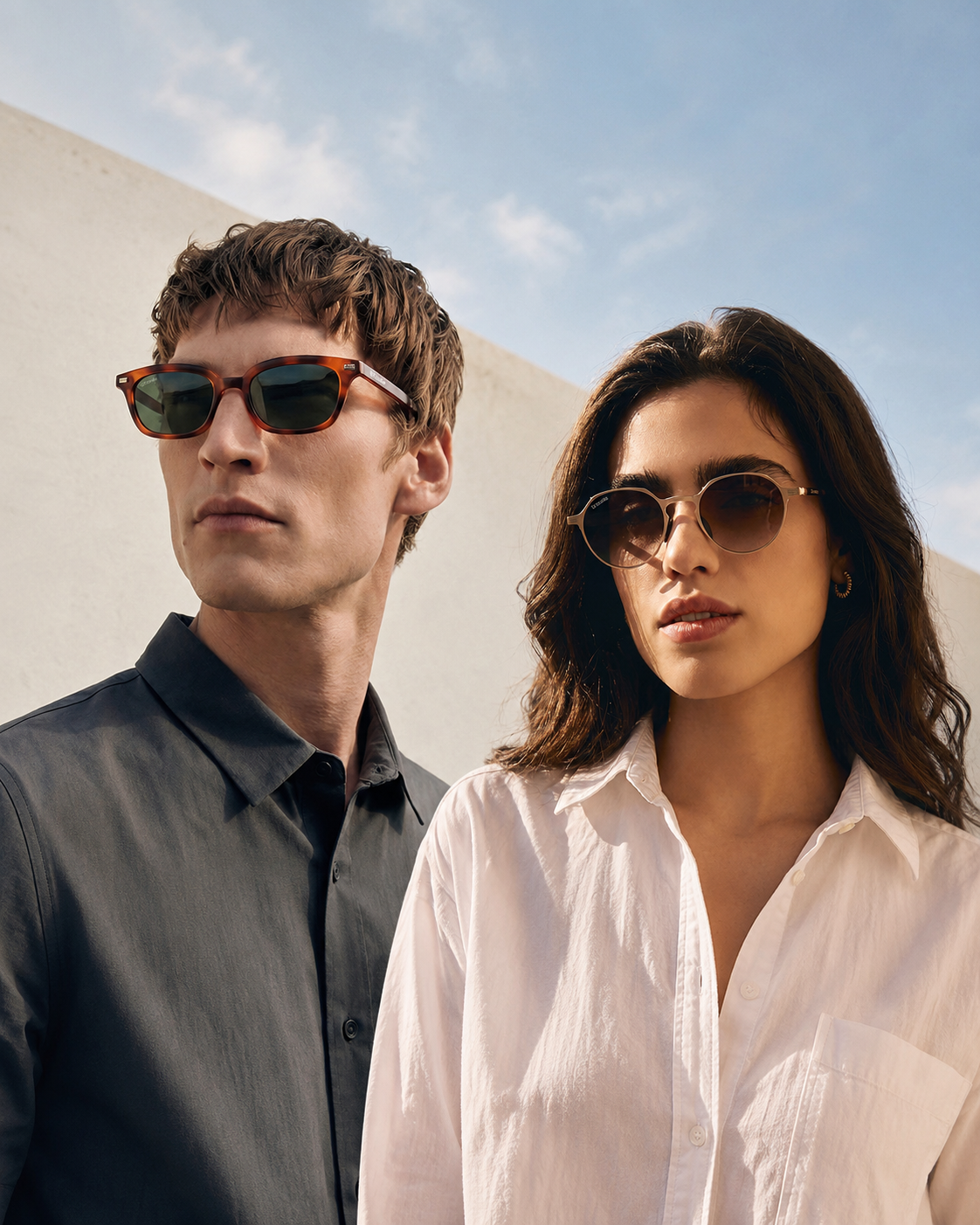
The UV400 protection label appears in almost every specification for quality sunglasses, yet it still raises questions. Here is a straightforward guide to what it means, how it affects your eyesight and how to choose your next pair without falling for common myths.
What UV400 protection means in sunglasses
UV400 protection indicates that the lens blocks between 99 and 100% of ultraviolet radiation at wavelengths up to 400 nanometres. It covers both UVA and UVB rays, meaning the entire UV light spectrum relevant to eye health.
In practical terms, glasses with UV400 protection act as a filter that stops harmful radiation before it reaches the eye’s natural lens and retina. This has nothing to do with how dark the lenses are, but rather with the treatment and material of the lenses themselves.
In the European Union, the UV400 label is usually accompanied by the CE mark, which certifies that the product meets minimum safety standards. If you cannot find a CE mark or a clear reference to UV protection, be cautious, however attractive the glasses may look.
The difference between UV400 and other protection levels
Any lens that blocks at least 99% of UV radiation up to 400 nm can be labelled UV400. Below that level, the lens may filter out some UV radiation, but it does not provide the level of protection considered safe for prolonged outdoor use. The risk of wearing glasses without UV400 protection is that dark lenses cause your pupils to dilate. Less visible light enters, but if UV radiation is not blocked, that extra UV can penetrate the eye more easily.
Why UV400 protection is essential for your eyes
Your skin has sunscreen; well-protected eyes have lenses with UV400 protection. Unfiltered ultraviolet radiation increases the risk of cataracts, macular degeneration and other conditions that develop over time rather than overnight.
As well as the eye itself, radiation affects the skin around it, one of the thinnest and most sensitive areas of the body. That familiar burning sensation around your eyes at the beach or in the mountains is a physical sign that protection has come too late.
If you spend long hours outdoors, exercise in the city or move between roads, water and reflective surfaces, wearing glasses without UV400 protection is more than uncomfortable; it exposes your eyes to a dose of radiation you could avoid by choosing the right lenses.
High-risk situations without UV400 protection
There are situations where a UV400 filter is essential: - Beaches and water sports: the water’s surface reflects a large proportion of UV radiation. - High mountains and snow: the combination of altitude and snow dramatically increases both direct and reflected radiation. - Cities in summer: tarmac, glass and metal increase reflections and glare. - Outdoor endurance sports: running, cycling, trail running and skiing involve hours of continuous exposure to full sunlight. In all these situations, dark lenses without UV400 protection are worse than wearing no glasses at all.
UV400 protection and polarised sunglasses are not the same
A common misconception is that polarised sunglasses offer greater protection against UV radiation. Polarisation and UV400 protection are two separate features that may or may not come together, depending on the quality of the product.
UV400 protection focuses on blocking ultraviolet radiation. Polarisation acts on reflected visible light, eliminating much of the horizontally reflected glare that causes eye strain, particularly on water, roads and snow.
The ideal sunglasses for intensive use combine both: UV400 protection to protect your eyes and polarisation to improve visual comfort and contrast. But do not assume a pair of glasses is safe simply because “polarised” appears prominently on the label.
How UV400 and polarisation work together in glasses
A technically comprehensive pair of glasses can be described as follows: - Lenses with UV400 protection: block UVA and UVB radiation up to 400 nm. - Polarising filter: reduces glare and improves contrast and clarity. - Additional treatments: an outer mirror coating, photochromic technology or a blue light filter for specific uses. In sports collections such as the athletic eyewear ranges for running, cycling and water sports, this combination makes the difference between a fashion accessory and a genuine tool for performance and protection. Within the urban range, models from collections such as roller may incorporate similar technology in a more lifestyle-oriented design.
UV400 protection and visible light filters
The term UV400 protection does not describe how dark a lens is or how much visible light it lets through. That is what light filter categories are for, usually ranging from 0 to 4.
Each category indicates the percentage of visible light that passes through the lens, but it does not describe how much UV radiation the lens blocks. A very lightly tinted lens can provide full UV400 protection; a very dark, inexpensive lens may offer none.
Light filter categories and their relationship with UV400
The standard classification of visible light filters can be summarised as follows: - Category 0: an almost transparent lens that lets through between 80 and 100% of light. - Category 1: a lightly tinted lens that filters out a small amount of light, suitable for cloudy days. - Category 2: a medium-tinted lens for moderate light conditions. - Category 3: a dark lens that lets through only 8 to 18% of light. This is the most common category for general outdoor use. - Category 4: a very dark lens for extreme conditions, such as high mountains or deserts; unsuitable for driving. In all these categories, you can find lenses with or without UV400 protection. What protects you from ultraviolet radiation is the UV treatment, not the darkness of the tint.
How lens colour affects UV400 protection
Lens colour affects your perception of light and how you see colours, but it does not determine UV400 protection on its own. You can have a light brown lens with full protection and a black lens without any reliable UV filter.
Certain tints change how you perceive your surroundings. For example, brown and amber tend to improve contrast, while grey generally preserves natural colours more accurately. When driving or playing sports, this matters just as much as comfort.
For everyday use, focus on two questions: does the lens clearly specify UV400 protection, with a CE mark and technical specifications? And does its colour allow safe colour perception for your activity, particularly when driving or taking part in technically demanding sports?
Common colours and recommended uses
Leaving colour marketing aside, there are some widely accepted patterns: - Grey: a balanced option for everyday use, with high colour accuracy. - Brown or amber: enhances contrast, useful for driving and outdoor sports. - Green: also offers a good balance between contrast and colour accuracy. - Unusual fashion tints without technical specifications: use them only if the product specifications confirm UV400 protection and an appropriate filter category. In urban collections such as sunglasses or lightweight ranges such as ultra light, the challenge is to combine fashionable colours and finishes with clear technical specifications that guarantee UV400 protection.

How to check whether glasses provide genuine UV400 protection
Beyond the label, there are objective signs that help you determine whether a pair of glasses’ UV400 protection is more than a marketing claim. You do not need a laboratory at home, but you do need to make an informed choice when buying.
The first clue is where the glasses come from and how they are sold. Glasses bought from unregulated retailers, beach stalls or marketplaces without technical information generally involve more uncertainty than a brand that publishes clear specifications covering materials, lens type and protection level.
The second clue is the documentation supplied with the product: the manual, hang tag or online specifications. These should include both the CE mark and an explicit reference to UV400 protection or the relevant European standard.
What to check before adding to your basket
Check at least the following points: - A visible CE mark on the frame or in the documentation. - An explicit reference to UV400 protection or blocking 99–100% of UVA and UVB radiation. - Information about the light filter category (0–4), appropriate for your intended use. - A consistent description of the lens type: standard, polarised, mirrored, photochromic or a combination. In well-organised catalogues, browsing complete listings such as all or specific collections such as 9xx helps you compare technical specifications instead of relying solely on the photograph.
UV400 protection in sports and technical eyewear
In running glasses, cycling glasses, ski goggles or water sports eyewear, UV400 protection is the starting point. The remaining features build on that foundation: polarisation, photochromic technology, panoramic lenses or ventilation.
During long sessions, the combination of radiation, wind and airborne particles increases stress on the eye’s surface. If the lenses do not block UV radiation properly, your eyes can become red, irritated and fatigued, with effects you notice at the end of the day as well as during your workout.
In snow or high mountains, wearing glasses without UV400 protection is a serious mistake. UV rays reach you directly and also reflect off the snow, producing an effect similar to sunburn, but on the eye and the surrounding skin.
Key features beyond UV400 protection
When choosing sports glasses with UV400 protection, you should also consider: - Lens type: polarised to reduce glare on roads or water; photochromic if you train in rapidly changing light conditions. - Coverage: wraparound designs that provide good protection at the sides to keep out light and wind. - Fit: temples and a bridge that keep the glasses secure without pressure points or bouncing as you move. - Weight: lightweight materials, particularly for long or high-intensity sessions. Proprietary lens technology, combined with UV400 protection and sport-specific designs, makes the difference between glasses that look good and glasses that stay comfortable throughout demanding training sessions.
Key takeaways about UV400 protection
UV400 protection means blocking almost all ultraviolet radiation up to 400 nm, including both UVA and UVB. It does not depend on lens colour or how dark the lenses appear.
The visible light filter level (categories 0 to 4) determines how much light enters your eyes, but it does not replace UV400 protection. The two specifications complement each other; neither cancels out the other.
Polarisation, lens colour and mirror finishes affect visual comfort and appearance, but they do not guarantee adequate protection on their own unless the UV400 filter is clearly specified.
Whenever you buy sunglasses, whether for everyday wear or sports, the logical order is simple: first, verified UV400 protection; next, a filter category suited to your intended use; and only then shape, colour and style.
UV400 protection is more than a minor technical detail: it is the minimum standard for treating your eyes with the same care you give your skin in the sun. Choosing glasses with clear, documented protection lets you enjoy the outdoors freely without turning every sunny outing into a long-term gamble with your eyesight.